
Guidelines for Interaction between Men and Women in Study and Work
Introduction
In language, ikhtilat (mixing) means blending and intermingling; one says “the people mixed” when they intermingled with one another (1).
As a term, in the context of relations between men and women, it is used for “a meeting between a man and a woman who is not his mahram, in a way that leads to suspicion” (2).
Suspicion here means a strong likelihood that something prohibited by the Sharia may occur, such as letting one’s gaze roam freely, improper speech, speaking softly and suggestively, or going beyond what is needed in conversation, not to mention what may happen by way of touching, bodily contact, being alone together, and other forms of overstepping the limits set by the Sharia.
Islam brought a system of manners and guidelines that organise how men and women deal with one another, preserve dignity and protect honour, achieve chastity and purity, and close the doors to temptation and corruption.
Among the most important of these guidelines are lowering the gaze, guarding one’s chastity, observing proper Islamic covering, avoiding being alone together, observing good manners in speech, limiting conversation to what is needed, avoiding soft and suggestive speech, and keeping away from anything that may stir temptation or open the doors to what is forbidden.
As education and work have expanded, and social and professional life has developed, interaction between men and women has become a reality in many settings, especially universities, educational institutions, workplaces, hospitals and various organisations. This reality raises an important question: how can male and female students and employees carry out their academic and professional duties competently, while at the same time preserving the guidelines of the Sharia and Islamic manners?
The aim is not to suspend learning, nor to prevent women from education and work, nor to consider interaction between the sexes forbidden in itself in every form. Rather, the aim is to identify the guidelines that keep such interaction disciplined when it is needed, far from being alone together, temptation and overstepping, so that fulfilling one’s duties and serving legitimate interests go hand in hand with preserving values and the rulings of the Sharia.
Hence the importance of studying this issue in a balanced way, distinguishing between the different forms of mixing, and between what need and benefit call for and what opens the doors to temptation or leads to the forbidden, while taking into account the reality of universities, workplaces and modern means of communication.
Accordingly, the question this article seeks to answer is:
How do we balance commitment to the Sharia’s guidelines in the dealings of men and women with the demands of education, work and contemporary life, without going to either extreme?
FirstInteraction between the sexes in Islam: guidelines, not an absolute ban
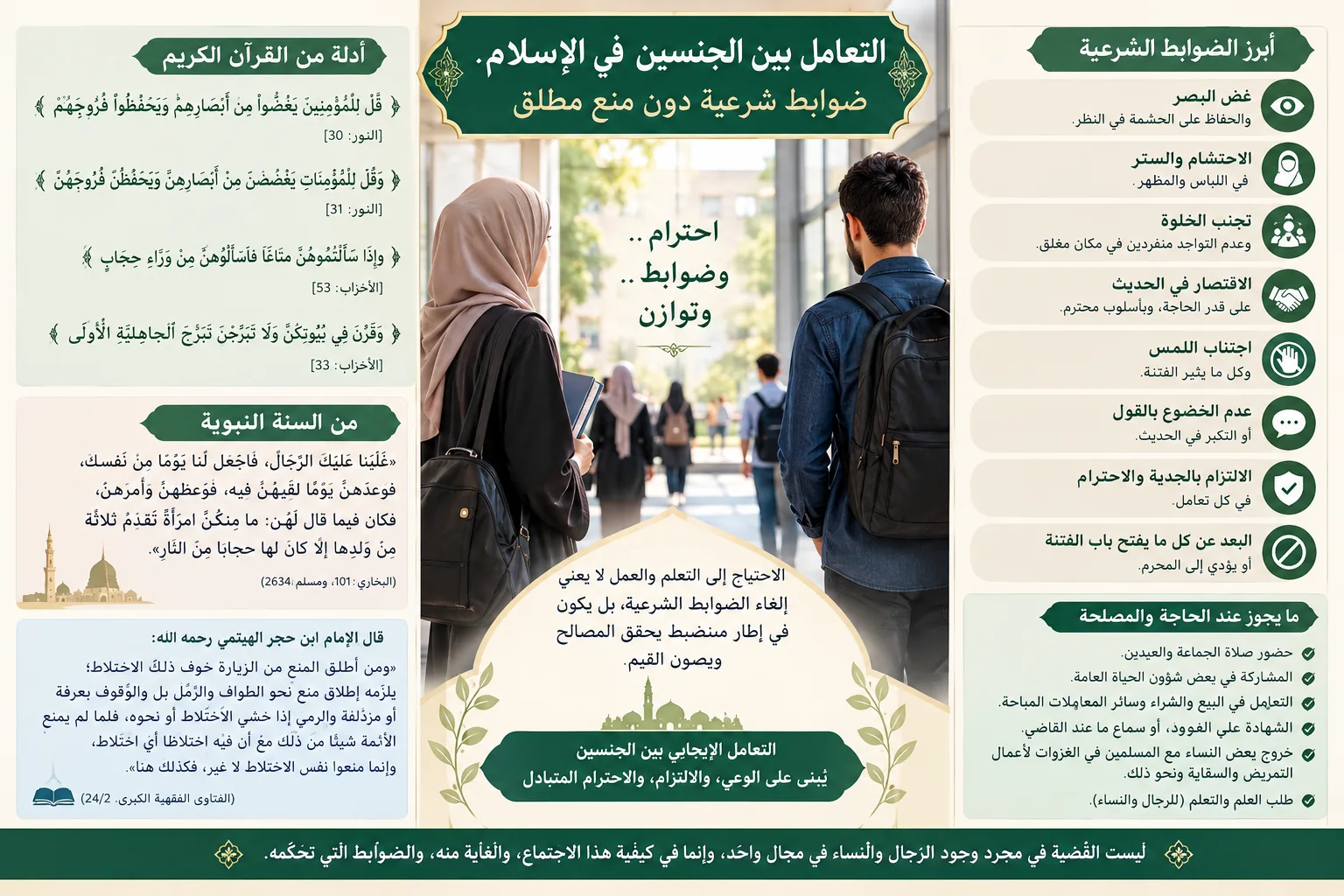
Islam did not impose an absolute ban on all interaction between men and women, nor did it leave such interaction without guidelines. Rather, it laid down a set of rulings and manners that preserve chastity, protect dignity and close the doors to temptation, while accepting the forms of interaction that legitimate need and benefit call for.
The texts of the Sharia confirm a number of these guidelines. Allah the Exalted commanded lowering the gaze, saying:
“Tell the believing men to reduce [some] of their vision and guard their private parts” [An-Nur: 30], and He commanded the believing women likewise, saying: “And tell the believing women to reduce [some] of their vision and guard their private parts” [An-Nur: 31].
Among the guidelines too is what came in the words of Allah the Exalted when addressing the Mothers of the Believers: “And when you ask [his wives] for something, ask them from behind a partition. That is purer for your hearts and their hearts” [Al-Ahzab: 53]. This verse came in a context specific to the Mothers of the Believers, while scholars have established that it points to a fundamental principle of manners and chastity in the interaction between men and women.
Allah the Exalted also said to the Mothers of the Believers: “And abide in your houses and do not display yourselves as [was] the display of the former times of ignorance” [Al-Ahzab: 33]. In its context this is addressed to the wives of the Prophet ﷺ. Ibn Ashur said: “This ruling is an obligation upon the Mothers of the Believers, and a perfection for all other women” (3). Al-Muhallab said: “It is not an obligation to remain in the houses” (4). And Ibn Kathir said: “Keep to your houses, and do not go out without need” (5).
On the other hand, these texts do not indicate that the Sharia barred women from all presence in public life, or forbade them all dealings with men. It is established in the Sunnah that women attended congregational and Eid prayers, performed tawaf and sa‘i in Hajj and Umrah, took part in some community affairs, and dealt with men in buying and selling, hiring and witnessing contracts; a woman would come before the judge to give testimony or to be heard so that a ruling could be made, along with other permissible dealings when needed. It is also established that some women went out with the Muslims on military expeditions to provide water, nurse the wounded and the like.
Among these is what Abu Sa‘id al-Khudri (may Allah be pleased with him) narrated: the women said to the Prophet ﷺ: “The men have taken all your time from us, so set aside a day for us yourself.” He promised them a day on which he met them, admonished them and gave them instructions. This hadith shows that it is legitimate for women to learn and seek knowledge, and legitimate to set aside a time for teaching and guiding them when needed. (6)
Accordingly, the mere presence of men and women together in one place is not enough on its own to judge a situation as forbidden; one must look at the nature of the gathering, its reason, its manner and the circumstances that accompany it. There is a difference between a gathering that a recognised need requires, such as education, work, medical treatment and transactions, and that takes place within a disciplined framework, and a gathering that involves being alone together, immodest display, touching, a forbidden gaze, soft and suggestive speech, flirtatious talk, or other things prohibited by the Sharia.
Imam Ibn Hajar al-Haytami (may Allah have mercy on him) pointed to this meaning when speaking about visiting graves and the gatherings of men and women that may occur there. He said: “Whoever bans visiting outright for fear of that mixing must likewise ban tawaf, ramal, and even standing at Arafah or Muzdalifah and the stoning, if mixing or the like is feared. Since the imams did not ban any of these, even though they involve mixing of every kind, but banned only the mixing itself, the same applies here” (7).
This text shows the importance of distinguishing between the gathering itself and the prohibited things that may accompany it; not every presence of men and women in one place takes the same ruling, rather rulings differ according to the circumstances and the effects that follow.
Hence, interaction between the sexes in universities and workplaces should be viewed in the light of this principle. Religious commitment should not turn into suspending the legitimate interests of education, work and genuine needs, just as the need to study or work should not become a pretext for abolishing the guidelines of the Sharia.
The balanced approach is to allow what recognised need and benefit call for, while preserving the guidelines of the Sharia, the most important of which are lowering the gaze, modesty, keeping away from being alone together, avoiding touch, limiting conversation to what is needed, seriousness and respect, and keeping away from anything that stirs temptation or opens the way to a gradual slide into the forbidden.
It thus becomes clear that the issue is not the mere presence of men and women in the same field, but how they come together, the purpose of it, the guidelines that govern it, and whether it serves a legitimate interest without involving anything the Sharia prohibits.
This distinction is essential when studying the reality of universities and workplaces today, because it makes it possible to combine preserving Islamic rulings and manners with fulfilling academic and professional duties and serving legitimate interests.
SecondLowering the gaze and preserving chastity
One of the most important guidelines established by Islam is lowering the gaze, an instruction that applies to men and women alike and is not the responsibility of women alone.
Allah the Exalted said: “Tell the believing men to reduce [some] of their vision and guard their private parts. That is purer for them. Indeed, Allah is Acquainted with what they do. And tell the believing women to reduce [some] of their vision and guard their private parts” [An-Nur: 30–31].
Allah the Exalted commanded the believing men and women to lower their gaze. Lowering the gaze means lowering it, restraining it and turning it away from looking at what it is not lawful to look at of the private parts. What is meant is not lowering the gaze absolutely, as if a person must keep his head bowed so that no man looks at a woman or vice versa, for this is something we cannot do. That is why Allah expressed it as “[some] of their vision”, meaning that they should lower some of their gaze. This excludes the sudden, unintended glance, as Muslim narrated in his Sahih from Jarir ibn Abdullah, who said: “I asked the Messenger of Allah about the sudden glance, and he told me to turn my eyes away” (8). And he said to Ali ibn Abi Talib (may Allah be pleased with him): “Do not follow one glance with another, for the first is yours but the second is not” (9).
In study and work settings, this instruction is applied by avoiding staring at others, following their movements, or looking at them in ways that carry harm, harassment or forbidden enjoyment.
Chastity is not limited to the gaze; it also covers speech, behaviour and intention, respect for others’ boundaries, and keeping away from any conduct intended to lure the other person into an illegitimate relationship.
ThirdModesty and appropriate dress
Among the guidelines of the Sharia is that the Muslim observes the manners of dress established by the Sharia, and maintains modesty and dignity in appearance, without deliberately displaying adornment in a way that contravenes the rulings of the Sharia.
Allah the Exalted said concerning the believing women: “and not expose their adornment except that which [necessarily] appears thereof and to wrap [a portion of] their headcovers over their chests” [An-Nur: 31]. And He said, in guidance to the wives of the Prophet ﷺ, with the general etiquette of address that the context contains:
“That is more suitable that they will be known and not be abused” [Al-Ahzab: 59]. Whenever such adornment loses its proper course, it becomes one of the greatest causes of temptation and corruption.
The details of the rulings on dress and what may show of it are a matter of juristic study, but the principle that should govern appearance is modesty and avoiding provocation or drawing attention.
Ibn Qayyim al-Jawziyyah said in I‘lam al-Muwaqqi‘in, speaking about the Sharia’s concern with blocking the means to harm: “He forbade a woman, when she goes out to the mosque, to wear perfume or incense, because that is a means to men’s inclination and desire for her; her scent, her adornment, her appearance and showing her beauty draw them to her. So he commanded her to go out without perfume, and not to wear perfume” (10).
FourthSpeech between the sexes: courtesy and clarity, without softness or affectation
A woman may speak in the presence of men who are not her mahrams when needed, provided that her speech is serious and to the point, without softness, temptation or provocation. Her voice is not ‘awrah according to the correct of the two scholarly views: women used to speak to the Prophet ﷺ and ask him questions, and they spoke to the Companions about their needs, and this was not objected to. They were only forbidden from speaking softly and suggestively, as Allah the Exalted said: “then do not be soft in speech [to men], lest he in whose heart is disease should covet, but speak with appropriate speech” [Al-Ahzab: 32].
The principle is that speech stays within the limits of its legitimate purpose, in a courteous and clear manner, avoiding expressions and hints that carry emotional or sexual suggestion or open the door to undisciplined attachment.
Examples of professional communication:
- A student asking a female classmate about an academic point he did not understand.
- A female employee discussing the details of a joint project with a colleague.
- A professor or supervisor explaining research requirements to female students.
- Members of a work team communicating to solve a technical or organisational problem.
What should be avoided is turning professional communication into flirtatious messages, repeated comments on appearance, emotional hints, or private conversations unrelated to the original need that become a means of attachment or overstepping limits.
FifthBeing alone together and the limits of face-to-face meetings
One of the important rulings to observe is avoiding forbidden seclusion between a man and a woman who is not his mahram.
Ibn Abbas (may Allah be pleased with them both) narrated that the Prophet ﷺ said: “No man should be alone with a woman unless she has a mahram with her” (11).
Forbidden seclusion means a man and a woman meeting in a situation where they are alone in the sense that constitutes seclusion in the Sharia; the details of applying the ruling to different places and circumstances are a matter for scholars.
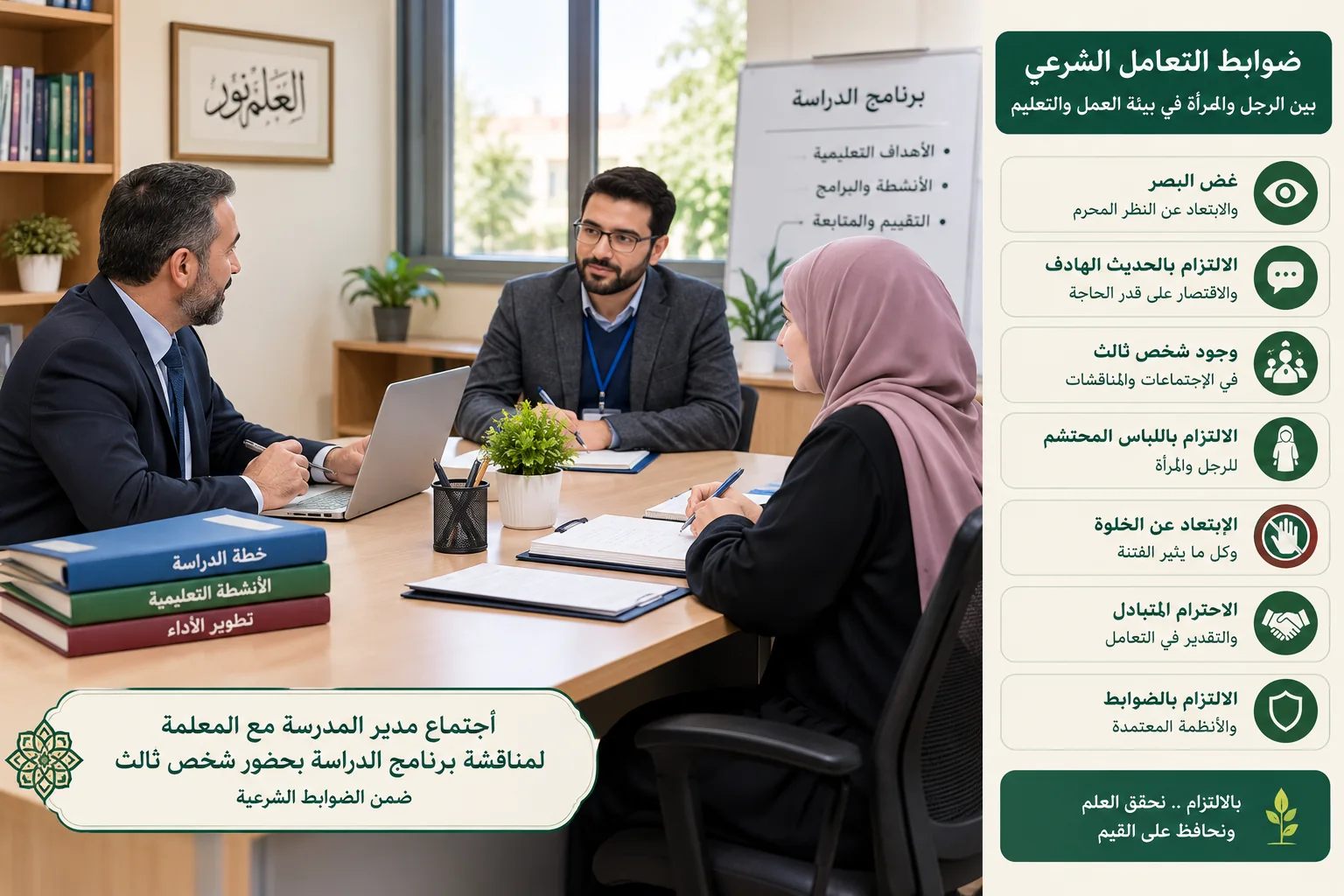
In study and work settings, this can be observed by holding meetings in suitable places, avoiding being alone in closed places where seclusion occurs, and choosing professional means that keep dealings clear and sound.
However, seclusion should not be confused with every conversation between a man and a woman. A conversation in a public hall, or in an open office where others can see what is happening, is not necessarily forbidden seclusion, although all the other guidelines must still be observed.
Likewise, the presence of a surveillance camera or a glass door is not enough on its own to judge every case; what counts is the reality of the place, the circumstances of the meeting and whether being alone actually occurs, not merely the name or shape of the place.
SixthReal-life examples at university
Example one: a joint graduation project
A group of male and female students may be asked to prepare a graduation project, divide the tasks among themselves, and stay in contact to follow up the work.
What to do: create a group dedicated to the project, set out the tasks and deadlines, use messages clearly and respectfully, and avoid turning the group into a space for flirting, personal comments or exchanging inappropriate content.
Not all communication has to happen during the day if study requires otherwise, but need, privacy and good manners should be observed, and the project should not be used as a pretext for repeated personal contact.
Example two: studying before an exam
A female student may need to discuss an academic question with a male classmate, or a male student may need the help of a female classmate who excels in her field.
What to do: choose a suitable place with a mahram of hers present, and stick to the subject of study and the manners of discussion.
SeventhReal-life examples at work
Example four: a meeting between a male and a female employee
The nature of the work may require an employee to discuss a report, a plan or an administrative decision with a female colleague.
What to do: the meeting should take place in a clear professional framework, in a place suited to the nature of the organisation, observing the rulings on seclusion, respecting professional privacy, and not turning the discussion into repeated personal conversation. It should take place with a third person present in every one-to-one meeting, to avoid forbidden seclusion.
Example five: joking and breaks at work
Constant joking or vulgar talk between male and female employees is not permissible in the Sharia, because of the doors to evil and temptation it may open and the barriers of modesty between the sexes it may remove. Nevertheless, some fatwa institutions have permitted passing words or light courtesy that does not go beyond the bounds of propriety and good manners, provided the following conditions are met:
- No temptation: each party is safe from inclination or suspicion.
- No soft, suggestive speech: the conversation does not involve affected speech or inappropriate expressions (such as joking about marriage or relationships).
- Respect and dignity: the joking does not involve obscenity, lies, mockery or frightening others.
The Prophet ﷺ used to joke with elderly women, saying only what was true; his joking had gentleness and wisdom, and took account of the people he addressed.
Among this is what is narrated of Umm Ayman (may Allah be pleased with her): she came to the Prophet ﷺ and said, “My husband invites you.” He said: “And who is he? Is he the one with white in his eye?” She said: “By Allah, there is no white in his eye.” He said: “Yes, there is white in his eye.” Then he explained to her that he meant the white that is in every person’s eye. Al-Ghazali mentioned this story in Ihya’ ‘Ulum al-Din.
Among this too is what is narrated from Aisha (may Allah be pleased with her): an elderly woman of the Ansar asked the Prophet ﷺ to pray to Allah for her to enter Paradise. He said to her: “O mother of so-and-so, no old woman will enter Paradise.” Then he explained to her that when Allah admits them to Paradise He will recreate them young, and so the distress Aisha (may Allah be pleased with her) had felt because of this word went away. (12)
Example six: comments on appearance and harassment
If a colleague habitually comments on a female colleague’s looks or clothes, or sends unwanted personal messages, this should not always be regarded as innocent flattery.
The other person has the right to ask clearly and politely for this behaviour to stop, and if the harm continues, to turn to the responsible manager or the organisation’s official channels.
Harassment can never be justified by the victim’s clothing, the nature of her work or her presence in a mixed place; the responsibility lies with the one who oversteps the limits and harms others.
EighthCommunication by phone and social media
Digital communication has become part of study and work, and messages, email and professional platforms may be necessary means of getting tasks done.
Some contemporary jurists stipulate that communication be formal, limited to the subject of work or study, and only as much as educational or professional need and necessity require, based on the principle that “what is permitted out of necessity is measured by its extent”. It is preferable for it to take place in shared groups (Group Chats) rather than private one-to-one conversations (Private Chats), to close the door to suspicion
The exceptions and allowances related to work or study do not mean opening the door wide; rather, the permission ends when the situation or task ends. Side conversations unrelated to the job or to study are not permissible, and one must return to the original principle (caution and reserve) as soon as the necessary reason has passed.
Practical guidelines that help keep such communication sound:
- Messages should be clear and related to study or work when using their official channels.
- Avoid messages that contain flirtation or inappropriate hints.
- Do not insist on personal contact if the other person shows they do not want it.
- Respect privacy, and do not share photos or conversations without permission or a valid reason.
- Do not exploit a professional need to pressure or blackmail the other person.
- Avoid turning a professional relationship into secret emotional contact that grows little by little until it oversteps the limits.
This does not mean that every message outside working hours, or all contact through an unofficial platform, is forbidden; circumstances may require it. The criterion is need, content, the manners of the Sharia, and not overstepping rights and limits.
NinthHandshakes and physical contact
A Muslim should observe the rulings on physical contact between the sexes as established by scholars. The majority of jurists hold that a man may not shake hands with a woman who is not his mahram, because doing so is forbidden. Ma‘qil ibn Yasar said: the Messenger of Allah ﷺ said: “For one of you to be stabbed in the head with an iron needle is better for him than to touch a woman who is not lawful for him” (13)
TenthHow do we set respectful limits without coldness?
Observing the guidelines does not require a person to be harsh or arrogant, or to treat colleagues as if they were always under suspicion.
Young men and women can combine good character with clarity, and express their limits without hurting anyone.
Suitable phrases include:
- I would prefer to keep our communication to the subject of the project
- Thank you; I would like us to communicate through the work group
- This kind of joking doesn’t suit me, and I would rather avoid it
- I’m happy to work together on the academic side, but I don’t wish to enter into a personal relationship.
- I’m sorry, I can’t meet in a secluded place; we can discuss it somewhere suitable
A confident person does not need to offend others in order to keep their limits; they can be polite and firm at the same time.
Nor should the responsibility for keeping the relationship in check be placed on one party alone; men and women are both responsible for their own conduct, for respecting the dignity of the other, and for avoiding harm and exploitation.
Conclusion: Chastity and success are not opposing paths
Study and work are important fields for building the person and serving society, and preserving religious and moral values is no obstacle to success; it is part of the responsibility that should accompany knowledge and work.
Chastity does not mean isolation from society, just as cooperation does not mean dropping all limits. Balance is achieved when a person does their duty with excellence, treats others fairly and respectfully, guards their gaze, tongue and conduct, and avoids forbidden seclusion and the transgressions that spoil relationships.
Let us remember that true character shows in everyday situations: in respecting a female colleague who does not return our admiration, in dealing with a colleague we disagree with, in refusing hurtful jokes, in doing our work honestly, and in respecting the privacy and limits of others.
Let us make our universities and institutions places where knowledge, productivity and respect prevail, where everyone has the chance to learn and work within a framework of dignity and responsibility.
Commitment is not coldness, good character is not laxity, and beneficial cooperation does not conflict with chastity; true refinement is when knowledge and work come together with piety and good conduct.
And Allah the Exalted says: “Indeed, Allah orders justice and good conduct and giving to relatives and forbids immorality and bad conduct and oppression. He admonishes you that perhaps you will be reminded” [An-Nahl: 90].
Keywords:
- guidelines for interaction between the sexes
- mixing at university
- interaction between young men and women
- workplace ethics in Islam
- lowering the gaze
- seclusion in Islamic law
- modesty and chastity
- relationships at work
- communication between the sexes
Notes and sources
- Al-Muhit fi al-Lughah (1/352). ↩
- Al-Ikhtilat bayna al-Jinsayn: Haqa’iq wa Tanbihat by Sheikh Sulayman ibn Salih ibn Abd al-Aziz al-Jarbu‘, with a foreword by Sheikh Salih ibn Fawzan al-Fawzan (p. 7). ↩
- Ibn Ashur, al-Tahrir wa al-Tanwir (22/10). ↩
- Quoted by Ibn al-Mulaqqin in al-Tawdih li-Sharh al-Jami‘ al-Sahih (11/40). ↩
- Ibn Kathir, Tafsir al-Qur’an al-‘Azim (6/409). ↩
- Narrated by al-Bukhari (101), Muslim (2634) and Ibn Hibban (2944) with slight differences. ↩
- Al-Fatawa al-Fiqhiyyah al-Kubra, 2/24. ↩
- Sahih Muslim, chapter on the sudden glance (3/1699); al-Sunan al-Kubra of al-Bayhaqi (7/86); Sahih Ibn Hibban (12/383). ↩
- Al-Mustadrak of al-Hakim (2/212); Sunan al-Tirmidhi (5/101); Sahih Ibn Hibban (12/381); Sharh Ma‘ani al-Athar (3/14). ↩
- Ibn Qayyim al-Jawziyyah, I‘lam al-Muwaqqi‘in, p. 234. ↩
- Narrated by al-Bukhari (3006) and Muslim (1341). ↩
- Graded hasan by al-Albani in Mukhtasar al-Shama’il, no. 205; it is also in al-Silsilah al-Sahihah, 2987. ↩
- Narrated by al-Ruyani in al-Musnad (1283) and al-Tabarani (20/212) (487), in their wording, and by al-Bayhaqi as in al-Targhib wa al-Tarhib of al-Mundhiri (3/26) with slight differences; see Sahih al-Jami‘ al-Saghir (5045). ↩